TL;DR: Custom Home vs Renovation in the Okanagan
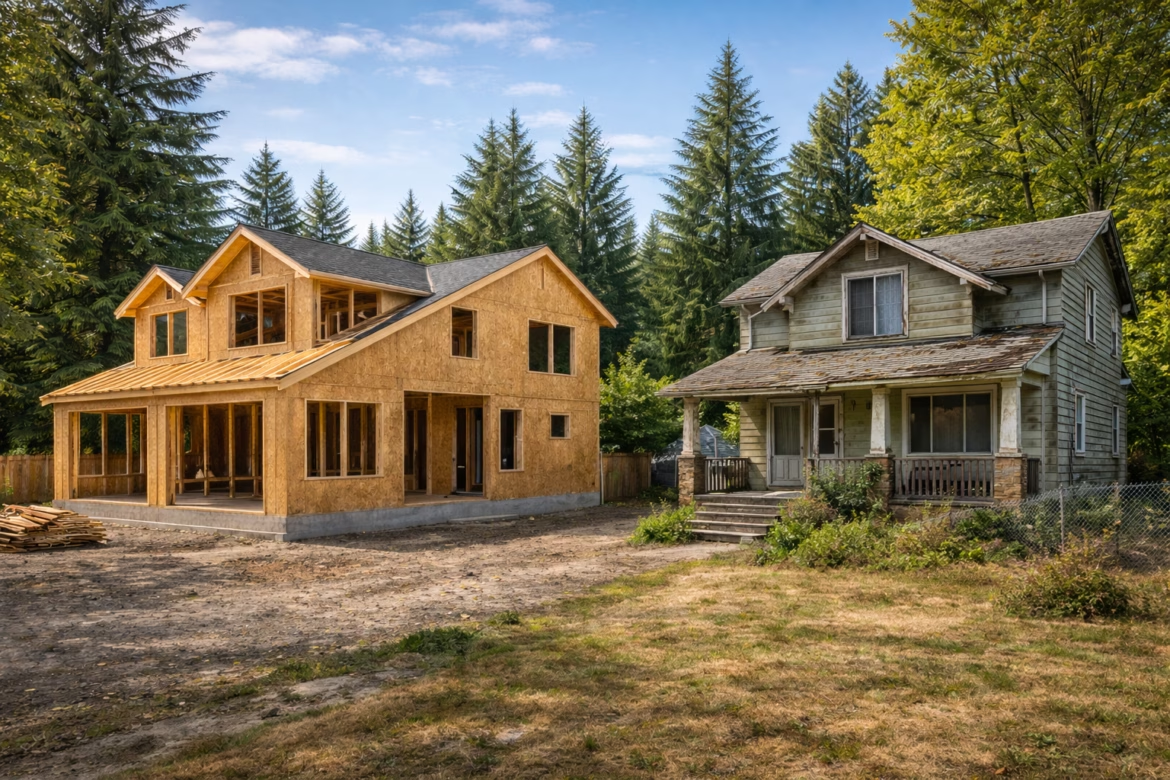
Renovating makes sense if you love your location, your home has good structural bones, and your goals can be met without major layout or foundation changes. Building a custom home is often the better option if your current house has significant limitations, requires extensive upgrades, or you want full control over layout, energy efficiency, and long-term design. In Kelowna, large renovations can approach the cost of a new build on a per-square-foot basis, so the decision often comes down to lifestyle disruption, budget certainty, land availability, and how long you plan to stay in the home.
If you love living in the Okanagan and your home isn’t quite your “dream home” yet, you might be asking yourself: Should we renovate our existing house, or build a brand-new custom home? It’s a big decision many Kelowna homeowners face. Both paths have their advantages, challenges, and costs. The right answer depends on your unique situation, from budget and timing to how much you value staying in your current location. In this article, we’ll walk through the key considerations to help you decide whether a custom home or a renovation makes more sense for you in the Okanagan.
Evaluating Your Goals and Current Home
Start with an honest assessment of what you want to achieve and what you’re working with:
- What do you dislike about your current home? Make a list. Is it too small, outdated in style, lacking modern features, poorly laid out, or in need of major repairs? Some issues can be fixed with a renovation (like updating finishes or removing a wall), but others might push you toward a rebuild (like a foundation in poor condition or a layout that can’t easily be altered).
- How much do you love your location? Location is irreplaceable. If you’re in a fantastic neighborhood or have an amazing lake view lot in Kelowna, staying put and renovating could be worth it – you can’t “renovate” a new view into a different property. On the other hand, if your current location isn’t ideal (perhaps a long commute or not the neighborhood you want long-term), building a custom home gives you a chance to choose a better lot.
- Future needs: Consider your family’s future. Are you planning to grow your family, work from home, or retire soon? A renovation can add a suite for an in-law or a home office, but only if your current house has the space/structure for it. With a custom build, you have a blank canvas to design for the next 20+ years of your life – multiple home offices, accessibility features, or whatever you foresee.
In short, if your current home has “good bones” and a renovation can address all your needs, it may make sense to renovate. But if there are structural limitations or you have a long list of dream features that just won’t fit into the existing shell, a custom new build might be the better route.
Cost Comparison – New Build vs. Major Renovation
For many, the decision comes down to cost. So, what’s more expensive: a full renovation or building new? It might surprise you, but a large-scale renovation in Kelowna can cost almost as much as building a new home, especially on a per-square-foot basis. According to recent data, a full gut renovation in Kelowna often ranges from $200 to $400 per square foot, depending on scope and finishes. That means renovating a 2,000 sq. ft. house could run on the order of $400k–$800k. By comparison, building a brand-new custom home is typically around $325 to $425 per square foot for a quality build (excluding land). So a 2,000 sq. ft. new home might be $650k–$850k for construction.
In pure construction dollars, you’re sometimes in the same ballpark. Renovations can be slightly cheaper if you’re not changing everything, but if you’re considering adding a large addition and refitting an older home entirely, the costs can approach new-build territory. One local builder noted that for a full-home renovation in Kelowna, $300/sq ft is a good midpoint to budget, versus $375/sq ft for a new build. Every project is different, but it underscores that renovations aren’t “cheap” compared to building new – they’re just distributed differently (and you already own the structure).
Understanding the Value and ROI
Another angle to consider is value or return on investment. Will spending those dollars yield a home you truly love and that’s worth the cost?
With a custom new home, every dollar goes toward exactly what you want. You get a brand-new structure (foundation, framing, everything) built to current code and energy efficiency standards. You can incorporate the latest technology and materials. Maintenance costs will be low (everything is new), and you get a full new-home warranty if built by a licensed builder. Market-wise, new homes tend to command higher prices; you’re essentially creating a 2025-built home which will likely appraise higher than a 1980s home that’s renovated to modern standards (though both can do well depending on quality). If you invest, say, $800k in a new home (plus land), you have a new asset that should align with other new builds in that price range on the market.
With a renovation, especially on an older home, you might be constrained by the existing structure. You can certainly increase your home’s value – for instance, modernizing a dated house in a good Kelowna neighborhood could significantly raise its market price – but there is a ceiling. If your home is the only heavily renovated one on a street of modest houses, you may not get every dollar back in resale (though if it’s your forever home, resale may be less important). One advantage: if you have an older house, renovating it means you keep some grandfathered features (like perhaps a bigger footprint than zoning now allows, or avoiding some development cost charges that new builds incur). But extensive renovations can uncover issues (like old wiring, plumbing, asbestos) that need fixing, and you must bring new work up to code – sometimes essentially rebuilding a lot of the house anyway.
In short, build new for maximum customization and long-term value; renovate if your house has redeeming qualities you want to preserve or leverage.
Budgeting for Surprises
One big consideration: renovations come with more surprises. When you tear into walls of an older home, you don’t always know what you’ll find – mold, outdated electrical, structural quirks, etc. That’s why renovation budgets need a healthy contingency (15-20%). With a new custom home, while you have more upfront expenses like land and development, the construction process is more straightforward – you’re starting from scratch, so fewer hidden surprises in the build itself (aside from site-related issues). If you’re risk-averse with budget, a new build provides more cost certainty once design is set, whereas renos require flexibility.
Timeline and Lifestyle Considerations
Cost aside, think about time and lifestyle:
- Can you live in the house during the work? Major renovations can be highly disruptive. If you plan to redo a kitchen, multiple bathrooms, and more, you may need to move out for a period. Living through a reno means dealing with noise, dust, and contractors coming and going for months. Building a new home, on the other hand, lets you stay put in your current place until the new house is ready (if you can afford to carry the current home or rent in the interim). However, building new typically takes longer overall than a moderate renovation – often around 10 to 16 months from breaking ground to move-in (plus design and permitting time before that), whereas a big renovation might be completed in, say, 4 to 8 months for a single-story whole-home update (depending on scope).
- Phasing and flexibility: With a renovation, you have the option to phase the project – maybe do the kitchen and main floor this year, and tackle the second floor next year, to spread out costs and disruption. A custom home is an all-in commitment (though you could build and finish some areas later, most folks complete it fully before moving in). If cash flow is a concern, phased renovating might be more feasible – but keep in mind multiple phases can increase total cost and prolong living in a construction zone.
- Quality of life: Consider your tolerance for stress. Some homeowners find renovations stressful due to dealing with an older structure’s quirks and having parts of the home unusable for a while. Others find the prospect of designing a new home and possibly selling/moving twice (sell current home, move to temporary rental, then move to new home) to be a bigger hassle. It’s a personal preference which path feels less disruptive. Families with young children or home-based businesses might lean towards building new to avoid constant renovation chaos, whereas retirees or those deeply rooted in their current home might prefer to renovate gradually.
Location, Land, and Permit Factors
Don’t forget external factors in Kelowna and the Okanagan:
- Land Availability: Do you already own land to build on? If not, you’d need to acquire a lot (and possibly demolish an old house on it). In some central Kelowna areas, empty lots are rare, so you might be looking at buying an older home to tear down. That adds to timeline and cost (demolition permits, removal of old structure). Renovating avoids land costs (you already have the lot), which can be a huge savings – land in Kelowna can easily be 30-50% of the total project cost for a new home.
- Permitting and Zoning: A renovation that stays within your home’s existing footprint and follows the rules may be simpler on permits than a new build. For example, if your current house is already slightly closer to the property line than new bylaws allow, you often can maintain that with a renovation (existing non-conforming), whereas a new build would have to comply with current setback rules or seek a variance. That said, any significant addition or structural change in Kelowna still requires building permits and must meet current code. Both renovation and new build will need permits; a new build might trigger more permits (tree removal, development permits if on a steep slope, etc.). The permit approval time for either can be a few months, though new builds could take longer if rezoning or multiple permits are involved.
- Heritage or Character: If your existing home has a historic or architectural character you cherish, renovation can preserve that while updating systems. Conversely, if it’s a standard older house with no particular charm, you might not feel tied to it and could start fresh.
- Sustainability: Renovating can be seen as environmentally friendly by reusing structure and materials where possible. Building new allows you to incorporate the latest energy-efficient technology (better insulation, solar, heat pumps, etc.) from scratch. Kelowna’s new building code (Step Code) pushes for efficient new homes. Renovations must also improve efficiency to meet code when possible, but you may not reach the same performance as a completely new build designed to a high energy standard.
Making the Right Choice for Your Situation (Conclusion)
There’s no one-size-fits-all answer to the custom home vs. renovation question. It truly depends on your home’s condition, your financial picture, and your personal priorities. To summarize:
- Choose a Renovation if: You love your current location and property, your home’s structure is sound, and you mainly want to modernize or slightly expand. Renovation can be cost-effective for targeted updates (kitchen redo, finishing a basement, adding a bedroom) and can increase your enjoyment and your home’s value without the ordeal of starting from ground zero. Just be sure to get a detailed quote and add a contingency for those “surprises” behind the walls. Renovation makes sense if you can get what you want by modifying what you have.
- Choose a Custom New Build if: You have a vision of your perfect home that your current house just can’t fulfill – whether due to size, layout, or structural constraints. Also, if your existing home would need so much work that you’re essentially rebuilding most of it, starting fresh can be cleaner and possibly smarter financially. A custom build is ideal if you want full control over design, energy efficiency, and materials – essentially a home tailored 100% to you. Yes, it requires finding a lot (or using your current lot and living elsewhere during construction) and it takes time, but you end up with a brand-new home with all-new components and warranty.
Many homeowners start by exploring both options: getting a renovation estimate and sketching out what a new build might entail (and cost). We often help clients evaluate both scenarios. Sometimes, we’ve concluded together that a renovation is the way to go. Other times, after seeing the scope needed, clients opt to build their dream home from scratch.
If you’re on the fence, it can be invaluable to consult with a builder (that’s us!) and perhaps a designer. We can assess your current home’s potential for renovation versus the blank slate of a new build. Our team has experience in both high-end renovations and custom new homes across Kelowna and the Okanagan, so we can offer an unbiased perspective on what it would take to achieve your goals each way.
Bottom line: both renovating and building new are significant projects – you want to get it right. The “right” choice is the one that will make you happiest in the long run, fits your budget, and aligns with your lifestyle. Whether you decide to transform the home you have or create a brand-new one, Maloff Contracting is here to help make it a success.
If you’d like to discuss your specific situation, reach out for a consultation. We can inspect your current home and provide honest feedback on renovation possibilities, or help you understand the process of designing and building a custom home in the Okanagan. Either way, our goal is to ensure you end up in your dream home – be it through renovation or new construction.
Not sure whether to renovate or rebuild? Contact Maloff Contracting for a friendly, professional assessment. We’ll help you weigh the pros and cons so you can move forward with confidence, turning your current house into the home you’ve always wanted – one way or the other.